
Dear student,
Kindly engage with the learning materials of unit 2.
4. Concepts of teaching, instruction, learning
4.4. Learning approaches
Activity:
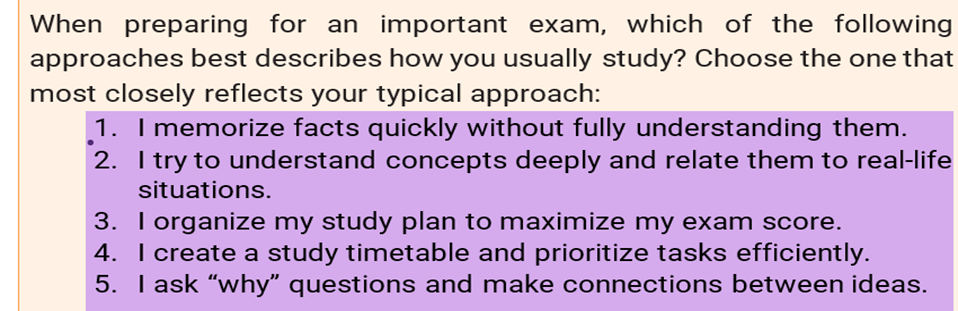
The term learning approaches refer to the strategies, methods, and mindsets that learners adopt to engage with new information and skills. These approaches describe the qualitative differences in how students go about learning and can vary widely based on individual preferences, the learning environment, intentions for learning, and cultural influences. The three main learning approaches are surface learning, strategic learning and deep learning.
A. Surface Learning
Surface learning refers to a narrow approach to learning in which students focus primarily on memorizing facts, completing tasks with minimal understanding, and meeting requirements without engaging deeply with the material. Learners who adopt a surface approach often aim to reproduce information just enough to pass exams or fulfill assignments, rather than to develop meaningful comprehension or apply knowledge in different contexts.
This type of learning is typically driven by external motivations, such as fear of failure, the desire for high grades or meeting external expectations, and is often associated with teaching environments that emphasize rote learning, high workload, or assessment-centered practices over conceptual understanding and critical thinking.
For example, in mathematics, a surface learner may focus on rote memorization of formulas without grasping the underlying concepts, while in language learning, they might memorize vocabulary lists without understanding how the words function in context or real-life communication. This approach can lead to fragile learning, where knowledge is easily forgotten and difficult to apply beyond the classroom.
B. Deep learning
Deep learning is an approach in which learners seek to understand ideas and concepts at a meaningful level rather than simply memorizing information. It involves actively engaging with the content, making connections between new and prior knowledge, and applying what is learned to real-life situations or new problems.
Deep learners are typically motivated by curiosity and a genuine interest in the subject matter. They analyze, evaluate, and reflect on what they learn, aiming for comprehension rather than mere performance. Deep learners are actively involved in the learning process, often extending their inquiry beyond what is taught to deepen their comprehension and apply knowledge in real-world or unfamiliar contexts. For example, in a history class, instead of memorizing dates and events, students analyze historical events and explore the impact of those events on modern society.
C. Strategic learning
Strategic learning is an approach in which learners aim to achieve the best possible academic outcomes by employing effective study techniques, time management, and goal-oriented behaviors. Strategic learners are typically highly motivated by achievement and grades, and they consciously adapt their learning methods to meet assessment requirements. They balance deep and surface learning strategies, using deep understanding when necessary but also relying on memorization or shortcuts when it serves their academic goals. Strategic learners are highly organized and efficient; they prioritize key content, practice with past exam papers, and adapt their strategies based on the nature of the task or evaluation.