Resources for unit 2
| Site: | UR - Elearning Platform |
| Course: | CE80241: Theories and practices of Teaching and Learning |
| Book: | Resources for unit 2 |
| Printed by: | Guest user |
| Date: | Tuesday, 22 September 2026, 11:59 PM |
Description
Dear student,
Kindly engage with the learning materials of unit 2.
1. Introduction
Activity
In your own words, what does the term ‘pedagogical concepts’ mean to you? Write your response on a sticky note and share with your classmates.
Having deep knowledge of key pedagogical concepts is essential for effective teaching and learning. These foundational ideas provide the framework through which teachers design, implement, and reflect on their instructional practices. This unit will explore core concepts in pedagogy, beginning with the term pedagogy, education, teaching and learning. It will also tackle the concept of didactics; including the didactic triangle, and didactic contract. Additionally, the concept of pupils’ representations, and meta-cognition will be discussed. Together, these concepts form a vital foundation for understanding how learning occurs and how it can be effectively facilitated in diverse educational settings.
2. Concept of pedagogy
Activity
 Meaning of Pedagogy
The word pedagogy comes from the Greek word "paidagōgia“,which is derived from two words: "pais", meaning "child" and "agōgos" meaning "leader" or "guide" (from the verb "agō", meaning "to lead" or "to bring"). Agogos is derived from the verb " ageirō ", which means "to lead “. Agogos refers to someone who leads, directs, or guides others, especially in the context of learning, teaching, or social movements. "Paidagōgia" literally means "the act of leading a child" or "the practice of guiding children.“
In ancient Greece, a paidagōgos was a slave or servant responsible for escorting and supervising the education of children. So, historically, the word pedagogy refers to a person who leads aactual implementation of teaching in real classroom situations. It involves what teachers do daily planning lessons, choosing teaching methods, interacting with learners, assessing progress, and managing the classroom. This is where theory and creativity come together and are applied in a specific context, such as a secondary school in Rwanda.
In essence, the definition shows that pedagogy integrates:
- Art → how creatively and skillfully teaching is delivered
- Science → the knowledge and theories that inform teaching
- Practice → the real-life application in the classroom
Together, these dimensions ensure that teaching is effective, informed, and responsive to learners’ needs. child, but this leader was not the “teacher”. The “pedagogue” was a slave who led a male child to school in the morning and then back home again in the afternoon.
Over time, the term slave evolved to refer more broadly to the theory and practice of education, not just the supervision of children.
Today, pedagogy refers to the art, science, and practice of teaching. This means that pedagogy is not just about teaching, it is a comprehensive concept that combines creativity, knowledge, and action in the teaching process.
When we say pedagogy is an art, we are emphasizing the teacher’s creativity, intuition, and personal skill in the classroom. Teaching is not mechanical; it requires the ability to explain ideas clearly, motivate learners, adapt to different abilities, and create an engaging learning environment. For example, a teacher may use storytelling, humor, or real-life examples to make a lesson more meaningful. These are artistic elements because they depend on the teacher’s style and judgment.
When pedagogy is described as a science, it highlights that teaching is based on systematic knowledge, research, and established theories about how people learn. Educational practices are informed by fields such as Educational Psychology and learning theories like Constructivism, which explain how learners process information and develop understanding. This means effective teaching is not guesswork; it relies on evidence-based methods such as reinforcement, feedback, and cognitive development principles.
Finally, pedagogy as a practice refers to the actual implementation of teaching in real classroom situations. It involves what teachers do daily planning lessons, choosing teaching methods, interacting with learners, assessing progress, and managing the classroom. This is where theory and creativity come together and are applied in a specific context, such as a secondary school in Rwanda.
In essence, the definition shows that pedagogy integrates:
- Art → how creatively and skillfully teaching is delivered
- Science → the knowledge and theories that inform teaching
- Practice → the real-life application in the classroom
Together, these dimensions ensure that teaching is effective, informed, and responsive to learners’ needs.
Pedagogy encompasses the methods, strategies, theories and principles that teachers use to facilitate learning, considering both what is taught and how it is taught, particularly in formal educational settings, especially the teaching children or young learners. Pedagogy involves understanding learners’ needs, designing appropriate learning experiences, and creating supportive learning environments that promote meaningful engagement and development. Pedagogy implies the science of the child (psychology), the knowledge of educational techniques and the art to put them into practice (pedagogy itself).
Pedagogy often focuses on foundational knowledge, skills, and behaviors that learners need for future learning. Pedagogy has a broader scope including educational philosophy, learner psychology, and classroom management (Shah and Campus, 2021). In a more detailed sense, pedagogy includes:
- Teaching methods (e.g., lecture, discussion, cooperative learning)
- Instructional strategies tailored to learners’ needs
- Classroom management techniques
- Assessment and evaluation practices
- Understanding of how students learn (educational psychology and developmental stages).
Effective pedagogy is not just about delivering content. It is about engaging learners, fostering critical thinking, and creating inclusive and supportive learning environments.
2.1. Key branches of pedagogy
Pedagogy comprises several branches that reflect the various aspects of teaching and learning. Each branch focuses on specific dimensions of education to guide effective instructional practice. Key branches of pedagogy include:
a. General pedagogy: This branch deals with the overall principles and theories of education, including teaching methods, learning processes, educational aims, and the philosophy of education.
b. Special pedagogy (Special Education): Focuses on teaching learners with special educational needs or disabilities. This branch develops inclusive methods and adaptive strategies to support diverse learning requirements.
c. Didactics: A central branch of pedagogy focused specifically on instruction. It explores how to teach particular content effectively, including curriculum design, teaching strategies, and the relationship between the teacher, learner, and subject matter.
d. Early childhood pedagogy: Concerned with the education of young children. This branch focuses on developmental stages, play-based learning, and age-appropriate methods to support early cognitive, social, and emotional growth.
e. Adult pedagogy (Andragogy): This branch addresses the education of adults, emphasizing self-directed learning, practical application, and the learners’ life experiences as central to the learning process. Andragogy is widely used in adult education programs, such as those found in community, vocational training, continuing education, or training; workplace learning and training programs to help employees improve job-related skills; many online education platforms by offering self-paced courses that allow adult learners to choose what they want to learn, when they want to learn it, and how they approach the material; and community-based learning and social movements like community workshops or groups where they can share their experiences and apply their learning in practical, socially relevant ways.
f. Social pedagogy: This branch emphasizes the social aspects of education. It is concerned with how education contributes to social development, integration, and personal well-being, often working with marginalized or at-risk populations.
Each of these branches contributes uniquely to the broader field of pedagogy, allowing teachers to tailor their teaching to specific contexts, learners, and goals.
3. Concept of Education
Activity:
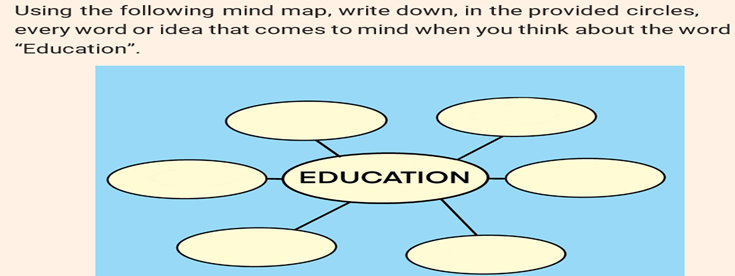
Meaning of education
Etymologically, the word education comes from the Latin word educatio, which is derived from the verb educare. The verb educare means to rear, to bring up, to educate, to nourish, or to feed in the sense of feeding, taking care of, and raising a child. The verb "educare” is derived from the combination of "e-": a prefix meaning "out" or "away." And "ducere": a verb that means "to lead." Thus, “Educere” means "to lead someone out of”. Therefore, "educare" literally means "to lead out" or "to bring forth." This reflects the idea of bringing out or developing one's potential, knowledge, or abilities, as is the goal of education. The noun form educatio refers to the act or process of rearing, nurturing, or training, and it later came to mean the process of educating or instruction, which is the meaning that the word education has retained in modern usage.
The word education entered the English language in the 16th century, where it was used to refer to instruction and the development of knowledge, skills, and character. Its meaning kept the original idea of “leading out” or “drawing forth” a person’s innate abilities. In this fundamental sense, education is understood as the process of guiding individuals out of ignorance and helping them develop their potential, knowledge, and capacities.
Different scholars have defined education in various ways. According to Durkheim (1968:41), education is “the action exercised by the adult generations on those who are not yet mature for social life.” In the same perspective, Morin and Brunet (1992:15) define education as “the action that consists in helping a human being to train himself, to develop himself, and to raise himself; it is also the result of his action.”
In contemporary understanding, education is viewed as a deliberate attempt to transmit and acquire accumulated worthwhile knowledge, understanding, skills, and attitudes from one generation to another. It is the process of facilitating learning or the acquisition of knowledge, skills, values, beliefs, and habits, as well as the process of teaching and learning that shapes the individual. It is the process of learning and teaching that involves the acquisition of knowledge, skills, values, attitudes, beliefs, and habits.
Through education, a person acquires competences, including knowledge, abilities, skills, attitudes, and values, which are developed in all circumstances of life. Through education, individuals are guided to develop intellectually, socially, morally, and emotionally to become productive members of society. At its core, education aims to:
- Develop human potential
- Transmit cultural heritage and values
- Promote critical thinking and problem-solving
- Prepare individuals for responsible citizenship and employment
- Foster lifelong learning and personal growth
In essence, education is both a personal and societal tool for transformation.
3.1. Forms of Education
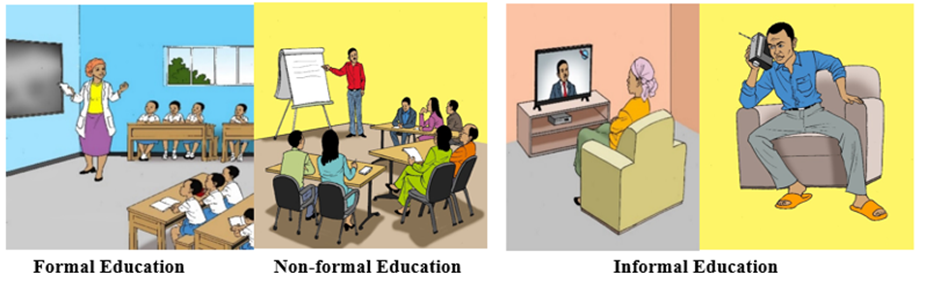
Education occurs in three main forms:
A. Formal Education
Formal education is both structured and regular, typically provided in schools, colleges, universities, or professional training centers. It follows a well-organized curriculum designed to meet specific educational goals and is usually divided into stages such as early childhood, primary, secondary, and higher education. Normally, formal education is delivered by certified teachers who possess professional qualifications and adhere to pedagogical standards. It includes formal assessments such as exams, quizzes, and projects that are standardized and contribute to students’ academic qualifications. Regulated by governmental or accreditation bodies, formal education ensures institutions meet specific standards and usually leads to recognized certifications such as diplomas or degrees as a formal recognition of their achievements.
B. Non-formal Education
Non-formal education is structured but not regular, occurring outside the traditional school system in settings such as workshops, training programs, seminars, conferences. It is designed to meet specific needs such as vocational skills, personal development, or lifelong learning. Unlike formal education, non-formal education does not follow a rigid curriculum and can be customized to suit the goals of participants.
It is normally voluntary; learners choose to participate based on their interests or needs. The content varies widely, focusing on practical skills or knowledge not typically covered in formal schooling. It often focuses on specific practical skills, personal development, or knowledge that may not be covered in formal education: vocational training, adult literacy programs, life skills courses, or hobby-based workshops.
It can take many forms, such as workshops, seminars, community learning circles, online courses, internships, apprenticeships, or even learning through social activities. It may offer certificates of completion or informal recognition of achievement, generally do not grant academic degrees or qualifications in the same way formal education does. The focus is often on personal or professional development rather than formal certification. Non form education is seen as essential for lifelong learning, bridging gaps left by formal education and addressing community or societal needs.
Both formal and non-formal education fall under hetero-education which means education guided by others as opposed to auto-education or self-directed education or education by oneself.
C. Informal Education
Informal education is both non-structured and non-regular, lacking a fixed curriculum or standardized learning pathway. It naturally emerges from daily experiences and activities occurring outside formal classroom settings and within everyday life.
This type of learning is acquired through personal reading, interpersonal relationships, life events, family interactions, community involvement, observation, and self-directed study. It is typically spontaneous and driven by the learner’s curiosity, motivation, and interests, making it highly adaptable to individual needs and circumstances rather than being guided by a predetermined educational framework.
4. Concepts of teaching, instruction, learning
Activity: How do you differentiate the term teaching, instruction and learning?
Introduction
Teaching, instruction, and learning are closely related concepts in the educational process. They form the foundation of classroom interaction and knowledge development. Understanding these concepts is essential because they help explain how knowledge is transmitted, facilitated, and acquired in educational settings.
4.1. Meaning of teaching
The word teaching has its origins in the idea of showing or pointing out, which is closely related to the modern meaning of educating or instructing someone. The term comes from the Old English verb tǣcan, which means to show, to point out, or to instruct. This Old English word is derived from the Proto-Germanic verb taikjan, meaning to show or to make known. During the Middle English period, the word appeared as techen, and it kept the meaning of showing, instructing, or guiding, but it gradually became associated with formal and organized instruction. In Modern English, the word teaching came to refer to the act of imparting knowledge, skills, values, or wisdom, as well as the profession and role of those who do so.
Contemporary, teaching refers to the overall process by which a teacher facilitates learning. This includes planning lessons, creating a supportive learning environment, guiding students, using various methods and strategies, managing the classroom, and assessing student progress. It defined as a set of steps, operations and conditions that are implemented by the environment (the teacher, parents, etc.) in order to facilitate learning. It is the process of imparting knowledge, skills, values, or behaviors to others, typically in an educational context. It involves guiding, instructing, and supporting students to understand concepts, develop critical thinking, and apply learning. It is often characterized by communication, interaction, and assessment of progress.
Teaching is not limited to the delivery of content, it also involves motivating learners, adapting to their needs, fostering critical thinking, personal development and a deeper understanding that can be applied in real-life contexts. Teaching involves planning, delivering, and assessing educational experiences to help learners achieve specific learning objectives. Teaching is both an art and a science:
-
- As an art, it involves creativity, empathy, communication, and adaptability.
- As a science, it draws on theories of learning, pedagogy, psychology, and educational research to make informed instructional decisions.
The key components of teaching include:
- Preparing lessons based on learners’ needs and curriculum goals
- Delivering instruction using appropriate methods and materials
- Engaging learners through questioning, interaction, and activities
- Assessing understanding and providing feedback
- Supporting learners’ development intellectually, emotionally, and socially
Effective teaching not only helps students learn facts or skills but also encourages critical thinking, curiosity, and lifelong learning.
4.2. Meaning of instruction
Instruction is a concept closely related to teaching, but it is more specific. It specifically refers to the deliberate act of delivering knowledge or skills, usually in a structured and systematic way. Instruction involves direct communication of information, such as explaining, demonstrating, or giving directions.
It focuses more on the “how” of content delivery within the broader teaching process. Instruction is a component of teaching. While teaching encompasses the full educational experience, instruction deals specifically with how lessons are presented to help learners acquire knowledge, skills and values.
4.3. Meaning of Learning
The word "learning" has its roots in Old English verb "leornian", meaning "to learn “, "to study or get knowledge “. It comes from the Proto-Germanic root "lizn-" or "leizn-", which also meant "to learn" or "to acquire knowledge. “
The verb "leornian" evolved into the noun "learning", which referred to the process of acquiring knowledge or understanding. By the 14th century, "learning" referred not only to the act of acquiring knowledge but also to the body of knowledge itself. The concept of "learning" as the process of acquiring and understanding knowledge has remained central to its meaning through its linguistic history.
Learning is a personal activity that consists of integrating new knowledge into the existing one. It is the process through which individuals acquire or modify knowledge, skills, attitudes, values, or behaviors through experience, study, practice, or instruction. It involves internalizing new information and applying it in meaningful ways, often leading to changes in understanding, thinking, or performance. Learning can be:
a. Cognitive (developing intellectual abilities like reasoning, problem- solving, and memory)
b. Affective (shaping attitudes, emotions, values, and motivation)
c. Psychomotor (acquiring and refining physical or motor skills)
In essence, learning is at the heart of personal development and education, it is how we grow intellectually, socially, emotionally, and physically across our lifespan.
Psychologists often define learning as a relatively permanent change in behavior as a result of experience or practice. This definition has three important terms:
§ Change in behavior: learning involves a change for better or worse
i.e. learning can involve both beneficial and negative behaviors. Sometimes people learn things that help them become more knowledgeable and lead better lives. In other instances, people can learn things that are detrimental to their overall health and well-being.
§ Change takes place through experience or practice; changes due to growth or maturation are not learning.
§ Before it can be called learning, the changes must be relatively permanent. What one learns is relatively permanent because it can be changed by future experience.
The ability to learn is possessed by humans, animals and machines. There is also evidence for some kind of learning in some plants. Learning is perhaps the most important human capacity. It is an ongoing process that takes place throughout all of life. Human learning begins before birth and continues until death as a consequence of ongoing interactions between person and environment.
Both concepts teaching and learning go together and we usually say: Teaching- learning process.
4.4. Learning approaches
Activity:
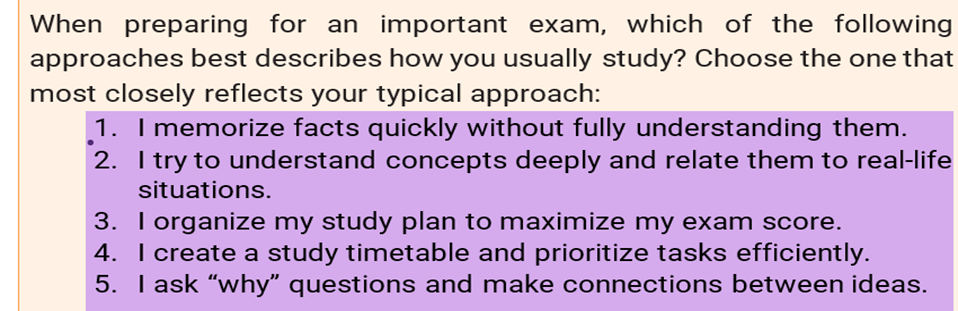
The term learning approaches refer to the strategies, methods, and mindsets that learners adopt to engage with new information and skills. These approaches describe the qualitative differences in how students go about learning and can vary widely based on individual preferences, the learning environment, intentions for learning, and cultural influences. The three main learning approaches are surface learning, strategic learning and deep learning.
A. Surface Learning
Surface learning refers to a narrow approach to learning in which students focus primarily on memorizing facts, completing tasks with minimal understanding, and meeting requirements without engaging deeply with the material. Learners who adopt a surface approach often aim to reproduce information just enough to pass exams or fulfill assignments, rather than to develop meaningful comprehension or apply knowledge in different contexts.
This type of learning is typically driven by external motivations, such as fear of failure, the desire for high grades or meeting external expectations, and is often associated with teaching environments that emphasize rote learning, high workload, or assessment-centered practices over conceptual understanding and critical thinking.
For example, in mathematics, a surface learner may focus on rote memorization of formulas without grasping the underlying concepts, while in language learning, they might memorize vocabulary lists without understanding how the words function in context or real-life communication. This approach can lead to fragile learning, where knowledge is easily forgotten and difficult to apply beyond the classroom.
B. Deep learning
Deep learning is an approach in which learners seek to understand ideas and concepts at a meaningful level rather than simply memorizing information. It involves actively engaging with the content, making connections between new and prior knowledge, and applying what is learned to real-life situations or new problems.
Deep learners are typically motivated by curiosity and a genuine interest in the subject matter. They analyze, evaluate, and reflect on what they learn, aiming for comprehension rather than mere performance. Deep learners are actively involved in the learning process, often extending their inquiry beyond what is taught to deepen their comprehension and apply knowledge in real-world or unfamiliar contexts. For example, in a history class, instead of memorizing dates and events, students analyze historical events and explore the impact of those events on modern society.
C. Strategic learning
Strategic learning is an approach in which learners aim to achieve the best possible academic outcomes by employing effective study techniques, time management, and goal-oriented behaviors. Strategic learners are typically highly motivated by achievement and grades, and they consciously adapt their learning methods to meet assessment requirements. They balance deep and surface learning strategies, using deep understanding when necessary but also relying on memorization or shortcuts when it serves their academic goals. Strategic learners are highly organized and efficient; they prioritize key content, practice with past exam papers, and adapt their strategies based on the nature of the task or evaluation.
5. Concept of didactics
Meaning of didactics
The term "didactics" has its roots in Greek and Latin. The word "didactics" comes from the Greek word "didaktikos", which means "apt to teach" or “suitable for teaching." The root of this word is "didaskalos” meaning "teacher."
The term was then borrowed into Latin as "didacticus", maintaining its meaning related to teaching or instruction. From Latin, the word entered modern European languages, including English, in the 17th century, where it came to refer to the art or science of teaching and the methods and principles of instruction, especially those applied in formal educational contexts.
Thus, "didactics" literally means the theory or practice of teaching, specifically focusing on instructional methods and the way knowledge is imparted to others. Didactics became more formally recognized as a discipline in the 18th and 19th centuries, especially in Europe. Notable figures, such as Johann Amos Comenius (famous educator, philosopher, and writer born in Moravia, which is today part of the Czech Republic), contributed to the development of didactics as a methodical approach to teaching with his most famous book Didactica Magna (The Great Didactic).
Didactics is a branch of pedagogy that specifically focuses on the theory and practice of instruction. It deals with the content of teaching (what to teach), the methods, strategies and techniques of delivery (how to teach), educational goals and objectives (why teach it), the learner’s characteristics and needs (to whom), learning environment and cultural/social setting (in what context) and the relationship between the teacher, the learner, and the subject matter, often illustrated by the didactic triangle.
Didactics concentrates more narrowly on the instructional process itself. It focuses on how knowledge is conveyed, understood, and applied by learners. It is more concerned with the instructional process. It deals with the design and delivery of teaching. Didactics is the field that helps educators make informed decisions about how best to teach a particular subject to a particular group of learners in a specific context.
5.1. Types of didactics
There are two types of didactics: General didactics, and subject- specific didactics.
A. General didactics
General didactics encompasses the fundamental principles, methods, and techniques of teaching that are applicable across a wide range of subjects and educational levels. It focuses on overarching aspects of the teaching and learning process, such as how to effectively engage students, structure and sequence lessons, and adapt instructional strategies to suit diverse learning needs and educational contexts. General didactics supports educators in making informed decisions about pedagogy, classroom management, and curriculum delivery, regardless of the specific subject matter.
B. Subject-specific didactics
Subject-specific didactics also called special didactics refers to the teaching strategies, methods, and instructional approaches tailored to specific subject areas, such as mathematics, language, history, or science. Unlike general didactics, which applies broadly across disciplines, special didactics focuses on the unique content structures, cognitive demands, and learning processes associated with each subject.
It provides subject-specific frameworks that guide educators in selecting the most effective ways to present content, address misconceptions, and foster deep understanding within a particular discipline. For example, the didactics of mathematics emphasize logical reasoning and problem-solving, while language didactics may focus on communication skills and grammar acquisition.
5.2. Didactic triangle
Activity: Write down the key elements that you consider essential for teaching and learning to take place
Every teaching and learning situation can be analysed through a triangular diagram called didactic triangle. The Didactic Triangle is a conceptual model that represents the core elements of the teaching and learning process. It highlights the relationship between three key components: Knowledge (K)/ Content (C), Learners (L) and Teacher (T):
- Knowledge (K) represents the content, disciplines, programs, subject matter, information, or material being taught and learned.
- Learners (L) refer to pupils, trainees, students. The student or individual who receives, processes, and engages with the knowledge or skills being taught.
- Teacher (T) refers to the lecturer, trainer, educator, initiator, etc. The individual responsible for imparting knowledge, guiding learning, and facilitating the overall learning experience.
A didactic triangle (Adapted from Djilali & Khemmad, 2023).
A. Relationship between elements of the didactic triangle
v Teacher ↔ Learner: This relationship is crucial for effective communication, understanding, and feedback. The teacher must be able to connect with the learner, recognize their needs, and adapt their teaching approach accordingly.
v Teacher ↔ Knowledge/Content: The teacher’s role involves selecting, structuring, and presenting content in an engaging and comprehensible way. The teacher needs to have a deep understanding of the content and how best to teach it.
v Learner ↔ Knowledge/Content: this represents how the learner interacts with the material. The learner engages with the content, makes sense of it, and internalizes or applies it. This relationship is mostly influenced by the learner’s prior knowledge, motivation, and learning strategies.
B. Significance of the didactic triangle
Didactic triangle has a huge significance:
- It emphasizes that teaching is not a one-directional act but a dynamic process involving constant interaction between the teacher, the learner, and the content. The teacher must not only deliver subject matter but also adapt it to the learners’ needs, prior knowledge, and learning styles. This requires thoughtful planning, flexibility, and awareness of pedagogical strategies.
- The triangle highlights the learner’s active role in constructing knowledge. Learning is not merely receiving information but engaging with content through exploration, questioning, and reflection. The learner’s interaction with both the teacher and the content is crucial for deep understanding.
- It indicates the dynamic and interdependent relationship between the teacher, the learner, and the content, serving as a foundational framework for understanding effective teaching and learning: It emphasizes that successful education is not only dependent on the teacher’s ability to deliver content, but equally on the learner’s active engagement and the relevance and clarity of the content itself. The model also emphasizes that effective teaching depends not only on the content itself but also on the interaction between the teacher and the student. It illustrates that the quality of interactions among these three elements significantly influences the overall effectiveness of the learning experience.
- The didactic triangle serves as a diagnostic and reflective tool for teachers. When challenges arise in the classroom, analyzing which link in the triangle is weak—teacher-learner, learner-content, or teacher-content—can guide improvements in instructional practice.
- The didactic triangle underscores that quality teaching depends on the harmonious interplay of its three elements, making it a vital model for both novice and experienced teachers.
5.3. Didactic contract
Activity: Read carefully these two questions and provide at least three answers for each question:
1. What do you expect your teachers to do in class?
2. What do teachers expect you to do as a student?
A. Meaning of didactic contract
The didactic contract refers to the implicit and explicit agreement between the teacher and the student regarding expectations, roles, responsibilities, norms and behaviours. It governs the relationship between the teacher, the learner, and the content being taught during the teaching and learning process. It outlines what both the teacher and the learner are expected to contribute to ensure effective learning (Hausberger & Patras , 2019). Didactic contract has two types which are implicit contract and explicit contract.
B. Types of didactic contracts
i. Implicit contract: Often unspoken expectations, roles, responsibilities, and norms; this refers to the natural, expected dynamics between teacher and student. For example, it is generally assumed that students will attend class, complete assignments, and the teacher will provide instruction and assessments, students expect teachers to give hints when they are stuck, teachers expect students not to interrupt when explaining.
ii. Explicit contract: This is a formal where the roles, responsibilities, and expectations of both the teacher and the learner are clearly outlined or stated. It could be in the form of a syllabus, classroom rules, or a specific learning agreement. For instance, students raise their hand to speak, students must complete a given assignment by Friday, etc.
C. Key elements of a didactic contract
i. Teacher’s roles and expectations
The teacher’s role and expectations are central components of the didactic contract, shaping how teaching and learning unfold in the classroom. As part of this implicit agreement, the teacher is expected to play different roles including the following:
Ø Teacher’s roles
Facilitator of learning: teachers guide students in the learning process, encouraging inquiry, critical thinking, and independence rather than just delivering content.
Planner and organizer: teachers design lesson plans, structure learning activities, and manage classroom time effectively to meet curriculum goals.
Assessor: teachers evaluate student progress through formal and informal assessments, providing feedback that helps learners improve.
Mentor and role model: Teachers model ethical behavior, communication skills, and lifelong learning attitudes, influencing students both academically and morally.
Curriculum implementer: Teachers interpret and deliver the curriculum in ways that are meaningful and accessible to all learners, adapting it to different needs and contexts.
Classroom manager: Teachers create a positive, inclusive, and disciplined environment where all students feel respected, supported, and safe.
Counselor and supporter: Teachers provide emotional and social support, helping students navigate academic and personal challenges.
Lifelong learner: Teachers continuously improve their professional skills through training, reflection, and collaboration with colleagues.
Ø Expectations from teachers
The following are also part of expectations of what the teacher is supposed to have:
Professionalism: Teachers are expected to be punctual, prepared, respectful, and uphold high ethical and professional standards.
Inclusivity and equity: Teachers should accommodate diverse learning styles, backgrounds, and abilities, ensuring every learner has equal opportunities to succeed.
Effective communication: Teachers must communicate clearly with students, parents, and colleagues, fostering collaboration and understanding.
Adaptability: Teachers are expected to adjust their strategies in response to student needs, classroom dynamics, and changes in the education system.
Commitment to student success: Teachers are expected to be committed to helping all students reach their potential academically, socially, and emotionally.
Confidentiality and integrity: Teachers must respect students’ privacy and act with honesty and transparency in their professional conduct.
ii. Learner’s roles and expectations
Ø Learner’s roles
Active participant: learners are expected to take an active role in their education by engaging with learning activities, asking questions, and contributing to discussions.
Self-directed learner: learners should take responsibility for their own learning by managing time effectively, setting goals, and seeking help when needed.
Collaborator: learning often involves working with peers. Learners are expected to cooperate respectfully in group tasks, share ideas, and support one another’s understanding.
Critical thinker: learners should analyze, evaluate, and synthesize information rather than memorize facts. They are encouraged to form opinions and justify their reasoning.
Problem solver: learners are expected to apply knowledge in practical situations, reflect on challenges, and find creative solutions to academic and real-life problems.
Respectful community member: learners must contribute to a positive and inclusive classroom environment by showing respect for teachers, peers, and differing opinions.
Reflective individual: learners are encouraged to assess their progress, reflect on their learning experiences, and adjust improve.
Ø Expectations from learners
Active engagement: Learners are expected to participate in class activities, complete assignments, and maintain focus during lessons.
Respect for rules and authority: Learners must follow classroom rules, respect school policies, and show courtesy to teachers and classmates.
Punctuality and attendance: Regular and timely attendance is crucial for continuous learning and classroom involvement.
Preparedness: Learners should come to class with the necessary materials, having completed required readings or assignments in advance.
Academic integrity: Learners are expected to be honest in their work—avoiding plagiarism, cheating, or any dishonest behavior.
Willingness to learn: Learners must demonstrate a positive attitude toward learning, be open to feedback, and show perseverance even when tasks are challenging.
iii. Content and context
The subject matter to be taught and learnt and the methods used to teach and learn it are part of the didactic contract. Learners need to understand what they will learn and how the content will be delivered while the teacher needs to master the content, plan it and effectively teach in relation to their roles and responsibilities in the teaching and learning process.
6. Teachers’ professional standards in Rwanda
Activity: Write down at least three key characteristics that define a professional teacher.
6.1. Meaning of teachers’ professional standards
Teachers’ professional standards are a set of guidelines or benchmarks that define the knowledge, skills, attitudes, and behaviors expected of teachers. Teachers’ professional standards in Rwanda serve as a framework to guide and assess the knowledge, skills, values, and conduct expected of teachers at all levels of education.
These standards aim to promote high-quality teaching, professional accountability, and continuous development among educators. They provide clear benchmarks for effective teaching practices, ethical behavior, and professional growth, ensuring that teachers contribute meaningfully to learner achievement and national education goals. By adhering to these standards, teachers uphold the integrity of the profession and play a vital role in improving the overall quality of education in Rwanda.
6.2. Domains of professional teacher standards in Rwanda
Professional teacher standards in Rwanda are grouped under three domains: (1) Professional knowledge and understanding, (2) Professional skills, and (3) Professional attitudes and values (REB, 2020).

Each domain has descriptors in the form of standards indicators. The standards indicators are detailed descriptions of the knowledge, skills, attitudes and values associated with each domain. In the context of competence, knowledge defines what teachers must know in his/her teaching career. Attitudes and values represent beliefs that play a critical role in teachers’ practice and influence on the teaching and learning process.
Skills describe the application of teachers’ knowledge, attitudes and values in their practices. They are therefore observable and measurable behaviors that represent what teachers know, can do, believe and value teaching and learning.
B.1 Domain of professional knowledge and understanding
The standards for teachers’ professional knowledge and understanding include:
i. Knowledge and understanding of the learner
A professional teacher must demonstrate awareness of the physical, social, intellectual and emotional development of children, and know how to adapt teaching to support students’ education at different stages of child development. Such teachers should be able to examine the factors that constrain students’ ability to learn and propose adequate measures of how best to overcome them.
ii. Knowledge and understanding of the curriculum
A professional teacher has:
§ Adequate knowledge of the curriculum content relevant to her/his teaching subject.
§ Sufficient knowledge and understanding of the subject matter for teaching at the appropriate level;
§ Good understanding of how new knowledge in his/her subject area is acquired.
§ Good understanding of how subject knowledge is linked to other subjects and applied to life experiences.
§ Good knowledge of new developments in the subject area.
§ Good knowledge of the language of instruction.
iii. Knowledge and understanding of teaching and learning process
A professional teacher:
-
- Has up-to-date knowledge and understanding of when to use which teaching and learning methods;
- Has broad knowledge and understanding of how to use and adapt a variety of teaching and learning methods to provide opportunities for all learners to learn;
- Knows and understands how learners build knowledge, acquire skills and develop habits of mind.
- Knows and understands how learning is influenced by individual experiences, talents and prior learning, language as well as family and community values and socio- economic status.
- Has good knowledge and understanding of a variety of teaching and learning materials including ICT tools.
- Knows how to motivate learners and provide constructive feedback.
- Has adequate knowledge of managing time for teaching and learning.
-
iv. Knowledge and understanding of instructional planning
A professional teacher must:
- Understand the importance of instructional planning.
- Know how to write appropriate schemes of work and lesson plans.
- Know how to write lesson plans with clear learning objectives and relevant measurable outcomes.
v. Knowledge and understanding of learning assessment and evaluation strategies:
A professional teacher:
- Knows and understands the nature and use of different learning assessment strategies.
- Knows and understands how to use different assessment tools to
- identify learning difficulties, potentials, and talents of learners.
- Knows a variety of ways of assessing learning holistically including the cognitive, psycho-motor and affective domains.
- Knows and understands how information acquired through assessment processes is used to improve teaching and learning.
vi. Knowledge and understanding of parents’ involvement in education
A professional teacher:
-
- Knows and understands the family background of learners.
- Has knowledge and understanding of how the family background of learners influences learning.
- Knows the importance of parents’ involvement in their children’s learning.
- Knows how to get parents involved and engaged in the education of their children.
- Understands and empathizes with parents who have difficulties in involved with their children’s schoolwork.
vii. Knowledge and understanding of professional development
A professional teacher:
- Knows and appreciates that learning to teach well is a process.
- Has knowledge of research as a tool for professional development.
- Knows what is required to develop professionally.
- Knows and understands the professional standards for teachers in Rwanda and what is required to meet them.
- Knows and understands the importance of Continuous Professional Development Courses in his/her teaching career.
viii. Knowledge and understanding of career guidance and counselling
A professional teacher:
- Knows and understands the concept of career guidance and counselling.
- Knows and understands the principles of career guidance and counselling.
- Understands the importance of career guidance and counselling in education.
B.2 Domain of professional skills
The standards for teachers’ professional skills are the following:
I. Using learners’ data to inform teaching and learning:
A professional teacher:
- Has sufficient data concerning learner’s overall development, socio-economic status, past experiences, readiness for learning and preferred learning styles.
- Analyses learner’s data accurately and designs appropriate teaching strategies to improve learning.
- Demonstrates ability to manage the learning of individual students, groups of students and whole classes and adjust teaching plans to suit the stage of learner physical, social and cognitive development, such teacher is aware of socio-economic background, experiences and learning styles of the students.
- Responds to learner’s learning differences and special learning needs with appropriate teaching strategies.
- Identifies and anticipates a range of factors that hamper learners’ ability to learn, and devises teaching strategies to overcome them.
- Collaborates with professional colleagues and parents to know and understand the learners in order to better support their learning.
II. Implementing the curriculum:
A professional teacher:
- Demonstrates ability to teach the subject content and justify the chosen teaching strategy.
- Selects and logically sequence content for teaching in a series of learning experiences [lessons] in ways that facilitate learning.
- Structures lessons and teaching activities in a logical sequence to fit all learners’ needs.
- Links teaching content knowledge and skills to everyday life experiences.
- Facilitates students’ access to learning materials and environment.
- Critically analyze and use information effectively; integrates a variety of strategies, activities, and resources in the process of teaching and learning.
- Facilitates students access critically analyze and use information effectively.
III. Instructional planning:
A professional teacher:
- Uses learners’ data to guide instructional planning.
- Plans what to teach annually, termly, monthly, weekly and daily.
- Plans for whom they intend to teach.
- Plans how to teach.
- Outlines clearly the intended learning outcomes of each lesson,
- Plans time realistically for pacing, content mastery and transitions.
- Plans for differentiated instruction.
- Aligns lesson objectives to the subject content and learners’ needs.
- Aligns teaching activities to school vision, mission and values.
- Translates their instructional plans into teaching and learning actions.
- Describes the expected actions that students should be able to perform as they participate in the learning activities; plans assessment for/of learning.
- Plans, sets and assesses learner’s portfolio.
iv. Applying acquired skills to teaching:
A professional teacher:
- Sets clear, challenging and achievable learning goals that describe what students will learn.
- Demonstrates focus on teaching with appropriate learning objectives.
- Plans and implements well-structured and paced lessons as well as teaching activities that engage students and promote learning.
- Demonstrates ability to manage the learning of individuals, groups and whole class.
- Modifies teaching to suit the stage of the lesson.
- Builds on previous knowledge to support learners acquire and apply new knowledge, understanding and skills to meet learning objectives.
- Selects and uses appropriate teaching strategies supported by research and good practice to develop problem solving, critical and creative thinking, communication and collaboration skills.
- Selects, creates and uses a range of resources to engage students in learning.
v. Assessing, providing feedback reporting on learner’s performance:
A professional teacher:
- Develops, selects and uses formative and summative assessment strategies to assess learners learning.
- Aligns the assessment tasks to Learning Outcomes and content.
- Develops and clarifies assessment criteria.
- Participates in assessment moderation activities to support consistent and comparable judgment of learners learning.
- Provides timely, effective and appropriate feedback to learners about their achievement relative to their learning goals.
VI. Engaging professionally with colleagues, parents and the community:
A professional teacher:
- Establishes and maintains constructive collaborative relationships with parents regarding their children’s learning and well-being.
- Participates in professional and community networks and forums to broaden knowledge and improve practice.
- Provides relevant opportunities for parents to be involved in their children’s learning.
- Participates actively in community socioeconomic development.
VII. Engaging in continuous professional development:
A professional teacher:
- Uses the National Professional Standards for Teachers and pieces of advice from colleagues to identify and plan professional learning needs.
- Participates in continuous professional development to update knowledge and practice aligned to professional needs and school priorities.
- Contributes to collegial discussions and applies constructive feedback to improve professional knowledge and practice.
- Undertakes professional learning programs designed to address identified learners’ learning needs.
VIII. Providing career guidance and counselling services:
A professional teacher:
- Gives total attention to learners and values each of them as an individual.
- Demonstrates the ability to effectively listen to learners and provides feedback.
- Has the ability to ask relevant, open and closed questions and how to make questioning more effective to gain a deeper understanding of learner’s concern.
- Reflects on the learner’s experiences.
- Demonstrates the ability to put him/ herself in learner’s situation in order to build trust.
- Guides the learners to make the right choice in their future career.
- Identifies the areas in which learners can be provided with career guidance and counseling.
B.3 Domain of professional attitudes and values
Standards for teachers’ professional attitudes and values are the following:
- Care for the learners: showing genuine concern for their academic, emotional, and social well-being by creating a safe, supportive, and inclusive learning environment. It involves building positive relationships, listening to their needs, and responding with empathy to help them feel valued and motivated to learn.
- Respect for learners and colleagues: recognizing and valuing everyone’s dignity, opinions, and contributions within the learning environment. It involves treating others with fairness, kindness, and professionalism, regardless of differences in background, beliefs, or roles.
- Trustworthy: being honest, reliable, and dependable so that others can have confidence in your words and actions. A trustworthy person keeps their promises, follows through on commitments, and earns the respect of those around them.
- Integrity: consistently doing what is right and ethical, even when no one is watching. It involves being honest, fair, and having strong moral principles that guide your actions and decisions.
- Dialogue with learners and colleagues: engaging in open, respectful, and meaningful conversations to share ideas, solve problems, and build mutual understanding. It promotes collaboration, active listening, and the exchange of perspectives to enhance learning and professional relationships.
- Non-discriminatory: treating all individuals fairly and equally, without bias or prejudice based on characteristics such as race, gender, age, disability, or background. It ensures that everyone has the same opportunities and respect regardless of their differences.
- Responsible: being accountable for your actions and duties, reliably fulfilling your commitments and making thoughtful decisions. It involves taking ownership of the consequences of your behavior and acting with care and professionalism.
- Tolerant: showing acceptance and open-mindedness toward different opinions, behaviors, or cultures, even if they differ from your own. It includes respecting diversity and being patient with others’ beliefs and ways of life.
- Polite: showing good manners, respect, and consideration toward others in speech and behavior. It involves being courteous, kind, and thoughtful in interactions to create positive and respectful communication.
- Patriotic: having a strong love, loyalty, and devotion to one’s country. It is about showing pride in the nation’s values, culture, and heritage, and actively supporting its well-being and progress.
6.3. Activity
Activity: Teacher Uwase, a secondary school Geography teacher, is conducting a lesson on the effects of climate change on agriculture in Rwanda. She begins by showing a short video clip that illustrates recent climate challenges faced by Rwandan farmers. To deepen understanding, she organizes learners into small groups and assigns each group a specific region of Rwanda to analyze how climate change negatively affects local agriculture. Before the group activity begins, she clearly explains the task, expected behavior, and the importance of every student contributing. While monitoring the groups, she notices that one learner, Eric, is sitting quietly and not participating. Instead of scolding him, she kneels beside the group, gently encourages Eric, and reminds him that his ideas are valuable. She offers him a guiding question to help him get started and assigns him a manageable role within the group. After the group presentations, the teacher praises each group’s effort and provides feedback on how they could strengthen their arguments with more evidence. To conclude, she links the topic to Rwanda’s environmental protection strategies and asks learners to reflect on how climate change may affect their own communities.
Questions
1. Identify the elements of a didactic triangle found in the scenario
2. Highlight how the teacher in the scenario meets the teachers’ professional standards in Rwanda.
3. Based on the teachers’ professional standards in Rwanda, which aspects teacher Uwase needs to improve. Give suggestions on how she would improve.
7. Didactic transposition
Activity
Read the following sentence carefully and answer the questions that follows:
“Water evaporates due to the effect of heat energy which transforms liquid into vapor.”
1. Rewrite the sentence so that a secondary school learner can understand it.
2. Which sentence is easier to understand?
3. What did you change?
4. Why is it necessary to change the sentence before teaching?
7.1. Meaning of didactic transposition
Changing difficult knowledge into simple knowledge for learners is called didactic transposition. It means transforming original scientific knowledge into knowledge that can be taught and learned in the classroom. This transformation occurs because the knowledge created in universities or research centers is often too complex, too detailed, or not directly useful for learners. Therefore, curriculum developers, textbook writers, and teachers modify this knowledge so that it becomes understandable and teachable in the classroom.
The concept of didactic transposition was developed in the field of didactics, and introduced by Yves Chevallard, a French mathematician and didactician, who explained that the knowledge produced by scientists or specialists cannot be taught to learners in its original form. It must first be selected, simplified, organized, and adapted to the level of students and to the objectives of education. This transformation process is called didactic transposition.
In didactic transposition, knowledge is adjusted for different:
• Age groups: Knowledge is simplified for younger audiences, such as secondary vs. university students, primary vs. secondary students
• Educational system levels: Adjustments are made depending on the level of schooling, such as primary school vs. high school or higher education.
• Cultural contexts: Information might be altered to be more relevant or relatable to the cultural or geographical context of the learners.
• Learning environments: How knowledge is structured for in-person classes, online learning, or practical, hands-on environments.
7.2. Stages of didactic transposition
Didactic transposition usually involves two main stages: External didactic transposition and internal didactic transposition.
A. External didactic transposition:
Educational authorities and curriculum designers transform scientific knowledge into programs, syllabuses, and textbooks. External didactic transposition refers to the transformation of knowledge that takes place outside the classroom, before the content reaches the teacher and the learners.
In this stage, scientific or scholarly knowledge (produced by researchers and specialists) is selected, simplified, and organized by curriculum designers, education authorities, and textbook writers so that it can be taught in schools. In other words, external didactic transposition is the process through which scholarly knowledge becomes knowledge to be taught. For example, historical knowledge produced by historians is transformed into school history programs and textbooks prepared by the Ministry of Education.
Internal didactic transposition
The teacher adapts the content during lesson preparation and teaching so that learners can understand it. Internal didactic transposition refers to the transformation of knowledge that takes place inside the classroom, when the teacher prepares and delivers the lesson. At this stage, the teacher interprets the curriculum, selects teaching methods, gives explanations, uses examples, and adapts the content according to the learners’ level and context. Internal didactic transposition therefore transforms knowledge to be taught into knowledge actually taught and learned. For example, a teacher may simplify a concept, use local examples, or change the order of explanation to help students understand better.
In short, external didactic transposition occurs at the level of curriculum development and educational authorities, while internal didactic transposition occurs at the level of the teacher and the classroom practice.
7.3. The process of didactic triangle
The process of didactic transposition refers to the transformation that knowledge undergoes before it becomes teachable and learnable in the classroom.
- The process begins with scholarly knowledge (savoir savant), which is the knowledge created by researchers, scientists, historians, mathematicians, and other specialists. This knowledge is usually complex, detailed, and intended for experts, so it is not directly suitable for learners in schools.
- The next stage is knowledge to be taught (savoir à enseigner). At this level, the knowledge is selected, simplified, and organized by curriculum developers, education authorities, and textbook writers. They decide what content is important for learners, what should be removed, and how the content should be structured according to the level of education. This stage corresponds to external didactic transposition, because the transformation happens outside the classroom.
- The final stage is taught knowledge (savoir enseigné), which is the knowledge actually presented to learners by the teacher in the classroom. The teacher interprets the curriculum, chooses teaching methods, gives examples, and adapts the lesson to the learners’ abilities and context. This stage corresponds to internal didactic transposition, because the transformation takes place during teaching and learning activities.
Therefore, the process of didactic transposition can be summarized as a progression from scholarly knowledge → knowledge to be taught → taught knowledge, showing how academic knowledge is gradually adapted until it becomes understandable and meaningful for learners.

In summary, didactic transposition is the process through which scholarly knowledge is transformed into teachable and learnable knowledge, first by curriculum designers (external transposition) and then by the teacher in the classroom (internal transposition).
8. Pupil’s representations
Activity |
|
1. 1. Write down what you believe or know about the following topics by answering corresponding questions: |
|
|
|
|
2. 2. Which ideas/answers are scientifically or historically accurate and which are misconceptions, without correcting them yet. |
8.1. Meaning of pupils’ representations
Pupils’ representations refer to the ideas, beliefs, opinions, mental models or prior knowledge that learners already have about a topic, subject, concept, or phenomenon before they are taught it at school or during instruction. These representations come from daily life, previous learning, culture, family, media, language or personal experience, and they influence how pupils understand new knowledge (Gurung, 2021; Fyttas, et al., 2023; Susac, et al., 2023).
In teaching and didactics, pupils’ representations are important because learners do not come to class with empty minds. They already have their own way of explaining things, which may be correct, incomplete, or wrong. The teacher must first identify these representations and then help learners improve or change them through teaching.
For example, in science, some pupils may think that the sun moves around the Earth because they see the sun moving in the sky. This is a pupil’s representation. In history, a pupil may believe that all kings were good leaders, which is also a representation based on limited knowledge. In mathematics, a learner may think that multiplication always makes numbers bigger, which is not always true.
In didactics, taking into account pupils’ representations helps the teacher to adapt the lesson, correct misunderstandings, and guide learners toward correct scientific knowledge. Therefore, pupils’ representations are the starting point of teaching and learning, and they play an important role in the process of didactic transposition and effective instruction.
8.2. Key aspects of pupils’ representations
Understanding the key aspects of pupils’ representations is essential for designing effective instruction that builds on learners’ prior knowledge, experiences, and perspectives. Such aspects include the following:
a. Pre-existing conceptions: Pupils come to the classroom with ideas about how the world works. These ideas may be scientifically accurate, partially correct, or completely incorrect (misconceptions).
b. Constructed knowledge: Representations are not fixed; pupils continuously modify their understanding based on new experiences and learning. This is a constructivist view of learning.
c. Multiple modalities: Representations can be expressed in various ways:
• Verbal (what students say or write)
• Visual (drawings, mind maps,)
• Gestural or physical (body language or physical models)
• Symbolic (mathematical or scientific symbols and notations)
• Actions (physical actions or hands-on activities)
d. Personal and subjective: Each pupil constructs meaning in unique ways. Even when students use the same words, the underlying understanding may differ significantly.
8.3. Examples of pupils representations
- A child may believe that plants get their food from the soil, rather than understanding photosynthesis.
- In geography, a pupil may think that the Earth is flat or that the sun moves around the Earth.
- In mathematics, some pupils think multiplication always makes numbers bigger, which is not true when multiplying by fractions or decimals.
- A student may create a mental image of the water cycle to better understand how precipitation, evaporation, and condensation work (Conceptual representation: help learners make sense of new information by connecting it to what they already know).
- A student may use a graph to represent the relationship between variables in a scientific experiment (visual representation: helpful in clarifying abstract or complex ideas, making them easier to understand and remember).
- A student may describe a process or explain a solution to a problem using words (Verbal representations: help students clarify their thoughts and communicate their understanding to others).
- A student uses equations, formulas, or algebraic expressions as symbolic representations of relationships or phenomena (Symbolic representation: essential for working with mathematical concepts and abstract scientific ideas).
- A student builds a model or conducts an experiment in Physics (action-based representation): helps kinesthetic learners or those who learn better through movement and physical interaction. Used especially in subjects that require practical skills.
8.4. Working with pupils’ representations
Recognizing pupils’ representations is key to effective teaching in secondary schools, because it allows teachers to correct misconceptions, connect new knowledge to prior ideas, and design meaningful learning activities. Teachers can work with pupils’ representations by:
- Elicit prior knowledge through brainstorming, questioning, or diagnostic assessments.
- Visualize thinking using concept maps, drawings, or diagrams.
- Challenge misconceptions through guided inquiry, experiments, or real-life applications.
- Encourage metacognition by asking pupils to reflect on how their thinking has changed.
- Use formative assessment to track shifts in pupil understanding.
8.5. Importance of pupils’ representations in the teaching and learning process
Pupils’ representations matter in teaching because they provide insight into how learners perceive, interpret, and understand concepts. In education, a “representation” refers to the ways in which students mentally organize knowledge, express ideas, and construct meaning through words, drawings, models, diagrams, or actions.
These representations are important for several reasons:
- Reveal prior knowledge and misconceptions: Pupils’ representations show what students already know and how they think about a topic. Misconceptions, incomplete understanding, or alternative conceptions become visible, allowing teachers to address them directly rather than assuming uniform understanding.
- Guide instructional decisions: By analyzing pupils’ representations, teachers can tailor their teaching strategies to meet learners’ needs. For example, if students depict a scientific process incorrectly in a diagram, the teacher can focus on clarifying the steps and underlying principles.
- Promote active engagement: Encouraging students to create representations requires them to actively process information. This engagement helps deepen understanding, strengthens memory, and develops higher-order thinking skills such as analysis, synthesis, and evaluation.
- Support differentiation: Pupils represent knowledge in diverse ways depending on their learning styles, abilities, and backgrounds. Recognizing these differences enables teachers to differentiate instruction, provide multiple modes of explanation, and support all learners effectively.
- Facilitate assessment and feedback: Representations provide concrete evidence of learning. Teachers can assess comprehension, monitor progress, and give targeted feedback based on how students express their understanding.
- Encourage reflection and metacognition: When students create representations, they reflect on their own thinking and learning processes. This helps them become more aware of their understanding, identify gaps, and develop strategies for improvement.
Effective teaching does not simply replace misconceptions it builds on existing representations to guide students toward more accurate and deeper understanding.
8.6. Activity
1. Given the following examples of secondary school pupils’ representations:
• Biology: “Plants eat soil to get food.”
• Physics: “Heavier objects fall faster than lighter objects.”
• History: “The 1994 genocide against happened because one group wanted to harm the other group.”
2. Identify the misconception in each statement.
3. Suggest a teaching strategy to address it
4. Explain how understanding pupils’ representations helps plan lessons that build correct knowledge.
9. Concept of Metacognition
Activity: Think of three different ways you could remember a shopping list of 10 items without writing them down.
1. What strategies did you use to remember the items?
2. Why did you choose that strategy?
3. Did you change your strategy when one didn’t work?
9.1. Meaning of Metacognition
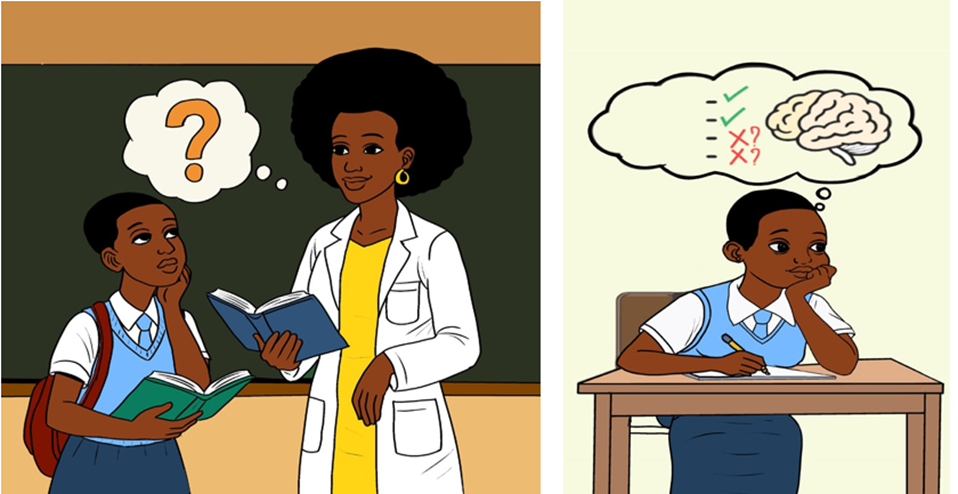
Metacognition refers to the awareness and understanding of one’s own thinking processes. It involves the ability to monitor, control, and regulate one’s cognitive activities in learning situations. Metacognition is “thinking about thinking”: the ability to think about and regulate one’s own thinking processes. It encompasses a variety of skills and strategies that help individuals reflect on their learning, plan how to approach a task, monitor their progress, and evaluate the effectiveness of their strategies. It involves being aware of how you learn, solve problems and make decisions, as well as how to recognize when a strategy is working or when adjustments are needed.
Example: A student knows that they are good at memorizing definitions but struggle with understanding complex concepts, so they use diagrams to help with conceptual understanding.
9.2. Key components of metacognition
Activity: Reflect on your learning of unit 2 of this module and respond to the
following questions:
1. What have I learnt about the key pedagogical concepts in Unit 2?
2. Do I fully understand each concept? If not, which ones are unclear?
3. Which learning strategies am I using to understand these concepts?
4. Are the strategies I am using effective in helping me understand Unit 2?
5. What changes or new strategies can I adopt to improve my understanding?
There are four main components of metacognition: Metacognitive knowledge, Metacognitive monitoring, Metacognitive control or regulation, and Metacognitive reflection.
A. Metacognitive knowledge
This involves knowing about oneself as a learner, knowing your strengths and weaknesses as a learner. It involves knowing about the strategies that work best for understanding and remembering information, and the nature of the task at hand. For example, if you can explain what your strengths are in academic writing, or exam taking, or other types of academic tasks, then you are metacognitively aware. Metacognitive knowledge can be broken down into three main types:
- Declarative knowledge: Knowing what you know (e.g. facts, concepts), or understanding the information and concepts you are learning and what strategies are available for learning.
 Procedural knowledge: Knowing how to perform certain tasks or how to use strategies effectively to process information, such as how to summarize, organize, or self-test.
- Conditional knowledge: Understanding when and why to use specific strategies, depending on the task or context; why a procedure or strategy succeeds in solving a problem, under what conditions and why a strategy is better than the other.
B. Metacognitive monitoring
Metacognitive monitoring refers to the ongoing process of checking and evaluating one’s own understanding, performance, or progress during a learning task. This involves self-assessment to identify when something is not working and needs to be changed. Metacognitive monitoring involves:
- Self-questioning: Asking questions like “Do I understand this?” or “Am I making progress?” while learning.
- Tracking progress: Continuously assessing whether current strategies are effective or whether a different approach is needed.
- Recognizing gaps: Realizing when knowledge or skills are missing or unclear and identifying when more effort is needed to understand something fully.
Example: While reading a chapter in a textbook, a student checks whether they can recall the main ideas from the previous section, deciding to review the material if they can’t.
C. Metacognitive control or regulation
The ability to control or adjust one’s cognitive processes to optimize learning. This includes deciding when and how to use strategies, when to switch strategies, and how to overcome obstacles. This is the active process of monitoring, controlling, and adjusting one’s cognitive processes during learning.
Examples:
- If a student realizes that highlighting the text is not helping them understand the material, they might switch to summarizing key points or discussing the material with a peer.
- A student might decide to take a short break after completing a set of practice problems in order to recharge and maintain focus for the next set.
D. Metacognitive reflection
Reflecting on one’s cognitive processes after completing a task. It involves evaluating what worked well, what didn’t, and how future performance can be improved. It involves:
- Self-reflection: Looking back on the strategies used and their effectiveness in solving a problem or completing a task.
- Analyzing successes and failures: Reviewing whether the chosen strategies led to success or failure and considering why.
- Adjusting for future tasks: Using reflection to guide future decisions about strategies, time management, and learning approaches.
Example: After finishing a test, a student reflects on the questions they found most challenging, evaluating which strategies helped them succeed and which ones need improvement for next time.
Other examples of metacognitive processes
a. Writing an essay:
- Planning: A student decides on a topic, outlines their argument, and plans when to write different sections of the essay.
- Monitoring: While writing, they periodically check to see if their arguments are clear and relevant to the topic.
- Control: If they find that their argument isn’t strong enough, they might
- change their thesis or gather more evidence.
- Reflection: After finishing, they reflect on what worked well in the writing process, such as organization or clarity, and what could be improved in the future.
b. Problem solving in Math:
- Planning: A student reads through the problem, breaks it down into smaller steps, and decides whether to use a formula or draw a diagram.
- Monitoring: As they work through the problem, they periodically check
- if their steps make sense or if they are stuck on a specific part.
- Control: If they get stuck, they decide to try another approach or seek help from a classmate.
- Reflection: After solving the problem, the student reflects on which strategies were most effective and how to approach similar problems next time.
9.3. Metacognitive strategies
Metacognitive strategies help students plan, monitor, and evaluate their learning processes, leading to improved comprehension, problem-solving, and academic performance. These strategies include the following:
- Self-questioning: Asking questions before, during, and after learning tasks (e.g., “What do I already know about this topic?” “How can I apply this information?” “Did I understand this correctly?”).
- Think-aloud: Verbalizing thoughts while solving problems or reading to make the thinking process explicit and help students identify errors or areas of confusion.
- Summarizing and paraphrasing: Writing or speaking summaries of what has been learned to ensure understanding and reinforce key concepts.
- Mind mapping: Using diagrams to organize and represent knowledge, helping learners visualize connections between concepts.
- Self-testing: Regularly testing oneself on the material to monitor understanding and retention, which helps reinforce learning and identify gaps in knowledge.
By applying these strategies, learners can take an active role in their learning journey, leading to deeper comprehension and long-term success.
9.4. Activity
Activity:
In a secondary school classroom, Ms. Uwase noticed that many students were struggling to understand complex science concepts despite reviewing their notes regularly. She introduced a new routine: before every topic, students were asked to write down what they already knew; during the lesson, they paused to ask themselves questions about the content; and after the lesson, they reflected on what worked well and what did not. One student, Mutesi, realized she was only memorizing facts without understanding them. She began using mind maps and summarizing information in her own words. Over time, her performance improved significantly.
Questions:
1. Based on the scenario, how did Mutesi demonstrate an understanding of metacognitive knowledge in her learning process?
2. What examples of metacognitive monitoring and control can you identify in Ms. Uwase’s teaching approach?
3. How does self-reflection, as shown in the scenario, contribute to improved learning outcomes.
4. If you were Mutesi, what additional metacognitive strategy would you apply to further enhance your understanding of complex topics?