
Benefits of grid computing
6. Reliability
High-end conventional computing systems use expensive hardware to increase reliability. They are built using chips with redundant circuits that vote on results, and contain logic to achieve graceful recovery from an assortment of hardware failures. The machines also use duplicate processors with hot pluggability so that when they fail, one can be replaced without turning the other off. Power supplies and cooling systems are duplicated. The systems are operated on special power sources that can start generators if utility power is interrupted. All of this builds a reliable system, but at a great cost, due to the duplication of expensive components.
In the future, we will see a complementary approach to reliability that relies on software and hardware. A grid is just the beginning of such technology. The systems in a grid can be relatively inexpensive and geographically dispersed.
Thus, if there is a power or other kind of failure at one location, the other parts of the grid are not likely to be affected. Grid management software can automatically resubmit jobs to other machines on the grid when a failure is detected. In critical, real-time situations, multiple copies of important jobs can be run on different machines throughout the grid, as illustrated in the next figure.
Their results can be checked for any kind of inconsistency, such as computer failures, data corruption, or tampering.
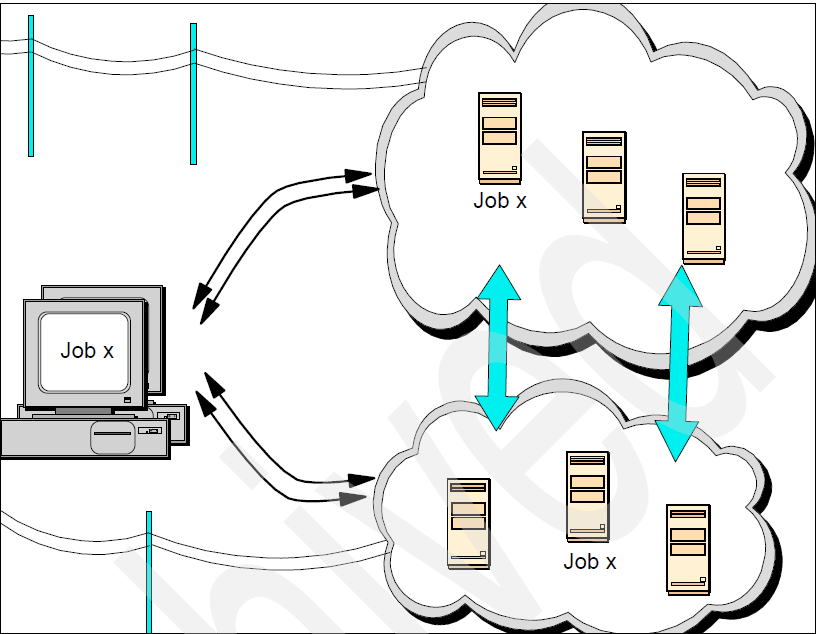
Redundant grid configuration
Such grid systems will utilize autonomic computing. This is a type of software that automatically heals problems in the grid, perhaps even before an operator or manager is aware of them. In principle, most of the reliability attributes achieved using hardware in today’s high availability systems can be achieved using software in a grid setting in the future.