Benefits of grid computing
| Site: | UR - Elearning Platform |
| Course: | COE4261 Grid Computing |
| Book: | Benefits of grid computing |
| Printed by: | Guest user |
| Date: | Thursday, 17 September 2026, 10:10 AM |
Description
Benefits of grid computing
1. Exploiting under utilized resources
One of the basic uses of grid computing is to run an existing application on a different machine. The machine on which the application is normally run might be unusually busy due to a peak in activity. The job in question could be run on an idle machine elsewhere on the grid.
There are at least two prerequisites for this scenario.
- 1. First, the application must be executable remotely and without undue overhead.
- 2. Second, the remote machine must meet any special hardware, software, or resource requirements imposed by the application.
For example, a batch job that spends a significant amount of time processing a set of input data to produce an output data set is perhaps the most ideal and simple use case for a grid. If the quantities of input and output are large, more thought and planning might be required to efficiently use the grid for such a job. It would usually not make sense to use a word processor remotely on a grid because there would probably be greater delays and more potential points of failure.
In most organizations, there are large amounts of underutilized computing resources. Most desktop machines are busy less than 5 percent of the time over a business day. In some organizations, even the server machines can often be relatively idle. Grid computing provides a framework for exploiting these under utilized resources and thus has the possibility of substantially increasing the efficiency of resource usage.
The processing resources are not the only ones that may be underutilized.
Often, machines may have enormous unused disk drive capacity. Grid computing (more specifically, a data grid) can be used to aggregate this unused storage into a much larger virtual data store, possibly configured to achieve improved performance and reliability over that of any single machine.
If a batch job needs to read a large amount of data, this data could be automatically replicated at various strategic points in the grid. Thus, if the job must be executed on a remote machine in the grid, the data is already there and does not need to be moved to that remote point. This offers clear performance benefits. Also, such copies of data can be used as backups when the primary copies are damaged or unavailable.
Another benefit of a grid is to better balance resource utilization. An organization may have occasional unexpected peaks of activity that demand more resources. If the applications are grid-enabled, they can be moved to under utilized machines during such peaks. In fact, some grid implementations can migrate partially completed jobs. In general, a grid can provide a consistent way to balance the loads on a wider federation of resources. This applies to CPU, storage, and any other types of resources that may be available on a grid.
2. Parallel CPU capacity
The potential for massive parallel CPU capacity is one of the most common visions and attractive features of a grid. In addition to pure scientific needs, such computing power is driving a new evolution in industries such as the bio-medical field, financial modeling, oil exploration, motion picture animation, and many others.
The common attribute among such uses is that the applications have been written to use algorithms that can be partitioned into independently running parts. A CPU-intensive grid application can be thought of as many smaller subjobs, each executing on a different machine in the grid. To the extent that these subjobs do not need to communicate with each other, the more scalable the application becomes. A perfectly scalable application will, for example, finish in one tenth of the time if it uses ten times the number of processors.
Barriers often exist to perfect scalability. The first barrier depends on the algorithms used for splitting the application among many CPUs. If the algorithm can only be split into a limited number of independently running parts, then that forms a scalability barrier. The second barrier appears if the parts are not completely independent; this can cause contention, which can limit scalability.
For example, if all of the subjobs need to read and write from one common file or database, the access limits of that file or database will become the limiting factor in the application’s scalability. Other sources of inter-job contention in a parallel grid application include message communications latencies among the jobs, network communication capacities, synchronization protocols, input-output bandwidth to storage or other devices, and other delays interfering with real-time requirements.
There are many factors to consider in grid-enabling an application. One must understand that not all applications can be transformed to run in parallel on a grid and achieve scalability. Furthermore, there are no practical tools for transforming arbitrary applications to exploit the parallel capabilities of a grid. There are some practical tools that skilled application designers can use to write a parallel grid application. However, automatic transformation of applications is a science in its infancy. This can be a difficult job and often requires mathematics and programming talents, if it is even possible in a given situation. New computation-intensive applications written today are being designed for parallel execution, and these will be easily grid-enabled, if they do not already follow emerging grid protocols and standards.
3. Virtual resources and virtual organizations for collaboration
Another capability enabled by grid computing is to provide an environment for ollaboration mong a wider audience. In the past, distributed computing promised this collaboration and achieved it to some extent. Grid computing can take these capabilities to an even wider udience, while offering important standards that enable very eterogeneous systems to work together to form the image of a large virtual computing system offering a variety of resources, as illustrated in the next figure. The users of the grid can be organized dynamically into a number of virtual organizations, each with different policy requirements. These virtual organizations can share their resources collectively as a larger grid.
Sharing starts with data in the form of files or databases. A data grid can expand data capabilities in several ways. First, files or databases can span many systems and thus have larger capacities than on any single system. Such spanning can improve data transfer rates through the use of striping techniques.
Data can be duplicated throughout the grid to serve as a backup and can be hosted on or near the machines most likely to need the data, in conjunction with advanced scheduling techniques.
Sharing is not limited to files, but also includes other resources, such as specialized devices, software, services, licenses, and so on. These resources are virtualized to give them a more uniform interoperability among heterogeneous grid participants.
The participants and users of the grid can be members of several real and virtual organizations. The grid can help in enforcing security rules among them and implement policies, which can resolve priorities for both resources and users.
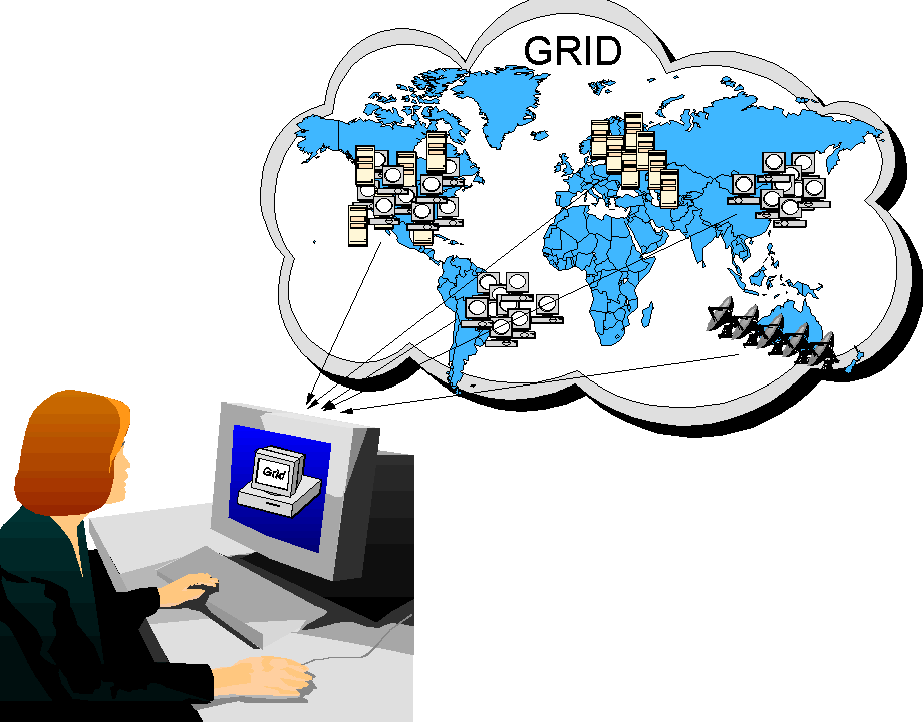
The grid virtualizes heterogeneous, geographically disperse resources
4. Access to additional resources
As already stated, in addition to CPU and storage resources, a grid can provide access to other resources as well. The additional resources can be provided in additional numbers and/or capacity. For example, if a user needs to increase their total bandwidth to the Internet to implement a data mining search engine, the work can be split among grid machines that have independent connections to the Internet. In this way, total searching capability is multiplied, since each machine has a separate connection to the Internet. If the machines had shared the connection to the Internet, there would not have been an effective increase in bandwidth.
Some machines may have expensive licensed software installed that users require. Users’ jobs can be sent to such machines, more fully exploiting the software licenses.
Some machines on the grid may have special devices. Most of us have used remote printers, perhaps with advanced color capabilities or faster speeds.
Similarly, a grid can be used to make use of other special equipment. For example, a machine may have a high speed, self-feeding DVD writer that could be used to publish a quantity of data faster. Some machines on the grid may be connected to scanning electron microscopes that can be operated remotely. In this case, scheduling and reservation are important. A specimen could be sent in advance to the facility hosting the microscope. Then the user can remotely operate the machine, changing perspective views until the desired image is captured.
The grid can enable more elaborate access, potentially to remote medical diagnostic and robotic surgery tools with two-way interaction from a distance.
The variations are limited only by one’s imagination. Today, we have remote device drivers for printers. Eventually, we will see standards for grid-enabled device drivers to many unusual devices and resources. All of these will make the grid look like a large system with a collection of resources beyond what would be available on just one conventional machine.
5. Resource balancing
A grid federates a large number of resources contributed by individual machines into a large single-system image. For applications that are grid-enabled, the grid can offer a resource balancing effect by scheduling grid jobs on machines with low utilization, as illustrated in the next figure.
This feature can prove invaluable for handling occasional peak loads of activity in parts of a larger organization. This can happen in two ways:
· An unexpected peak can be routed to relatively idle machines in the grid.
· If the grid is already fully utilized, the lowest priority work being performed on the grid can be temporarily suspended or even cancelled and performed again later to make room for the higher priority work.
Without a grid infrastructure, such balancing decisions are difficult to prioritize and execute.
Occasionally, a project may suddenly rise in importance with a specific deadline. A grid cannot perform a miracle and achieve a deadline when it is already too close. However, if the size of the job is known, if it is a kind of job that can be sufficiently split into subjobs, and if enough resources are available after preempting lower-priority work, a grid can bring a very large amount of processing power to solve the problem.
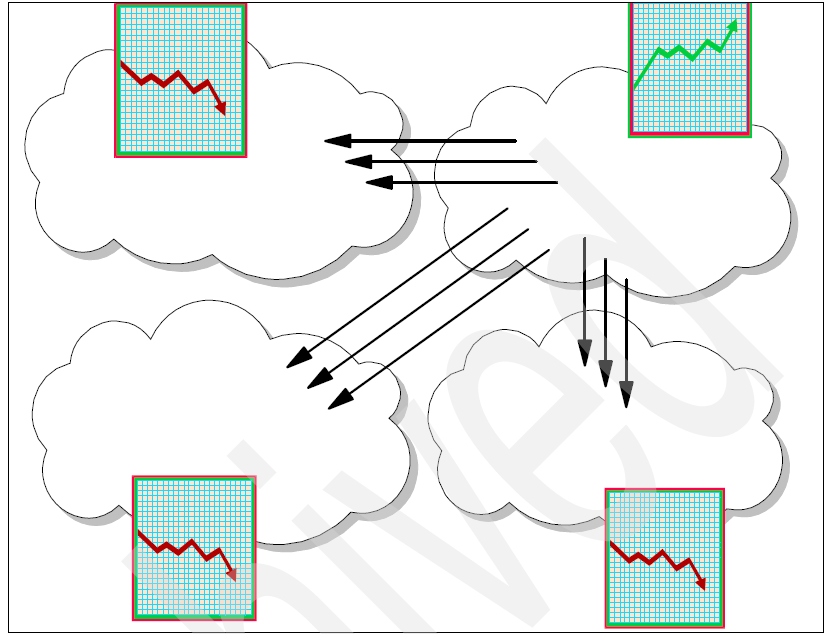
Jobs are migrated to less busy parts of the grid to balance loads
Other more subtle benefits can occur using a grid for load balancing. When jobs communicate with each other, the Internet, or with storage resources, an advanced scheduler could schedule them to minimize communications traffic or minimize the distance of the communications. This can potentially reduce communication and other forms of contention in the grid.
Finally, a grid provides excellent infrastructure for brokering resources. Individual resources can be profiled to determine their availability and their capacity, and this can be factored into scheduling on the grid. Depending on the accounting facilities in place, different organizations participating in the grid can build up grid credits and use them at times when they need additional resources. This can form the basis for grid accounting and the ability to more fairly distribute work
(and cost) on the grid.
6. Reliability
High-end conventional computing systems use expensive hardware to increase reliability. They are built using chips with redundant circuits that vote on results, and contain logic to achieve graceful recovery from an assortment of hardware failures. The machines also use duplicate processors with hot pluggability so that when they fail, one can be replaced without turning the other off. Power supplies and cooling systems are duplicated. The systems are operated on special power sources that can start generators if utility power is interrupted. All of this builds a reliable system, but at a great cost, due to the duplication of expensive components.
In the future, we will see a complementary approach to reliability that relies on software and hardware. A grid is just the beginning of such technology. The systems in a grid can be relatively inexpensive and geographically dispersed.
Thus, if there is a power or other kind of failure at one location, the other parts of the grid are not likely to be affected. Grid management software can automatically resubmit jobs to other machines on the grid when a failure is detected. In critical, real-time situations, multiple copies of important jobs can be run on different machines throughout the grid, as illustrated in the next figure.
Their results can be checked for any kind of inconsistency, such as computer failures, data corruption, or tampering.
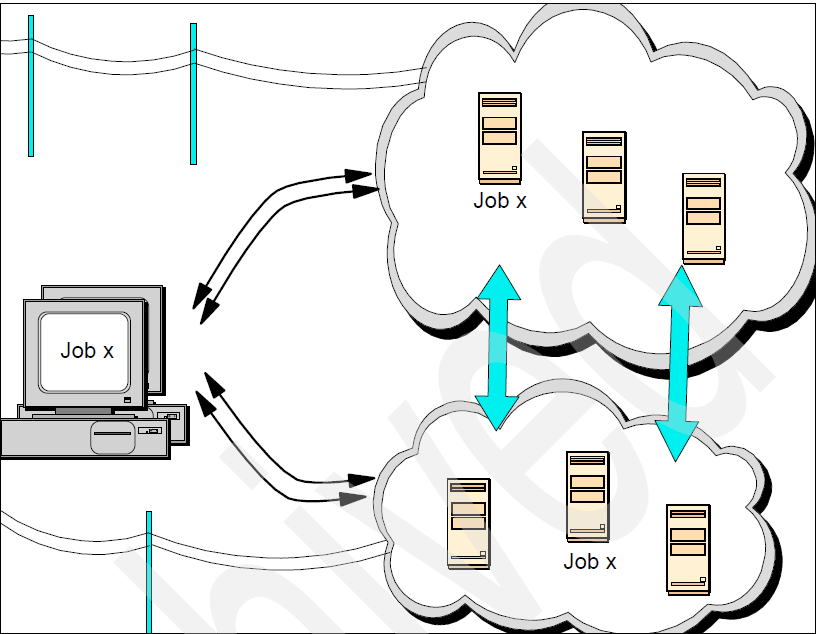
Redundant grid configuration
Such grid systems will utilize autonomic computing. This is a type of software that automatically heals problems in the grid, perhaps even before an operator or manager is aware of them. In principle, most of the reliability attributes achieved using hardware in today’s high availability systems can be achieved using software in a grid setting in the future.
7. Management
The goal to virtualize the resources on the grid and more uniformly handle heterogeneous systems will create new opportunities to better manage a larger, more distributed IT infrastructure. It will be easier to visualize capacity and utilization, making it easier for IT departments to control expenditures for computing resources over a larger organization.
The grid offers management of priorities among different projects. In the past, each project may have been responsible for its own IT resources and the associated expenses. Often these resources might be under utilized while another project finds itself in trouble, needing more resources due to unexpected events. With the larger view a grid can offer, it becomes easier to control and manage such situations. As illustrated in the next figure, administrators can change any number of policies that affect how the different organizations might share or compete for resources.
Aggregating utilization data over a larger set of projects can enhance an organization’s ability to project future upgrade needs. When maintenance is required, grid work can be rerouted to other machines without crippling the projects involved.
Autonomic computing can come into play here too. Various tools may be able to identify important trends throughout the grid, informing management of those that require attention.
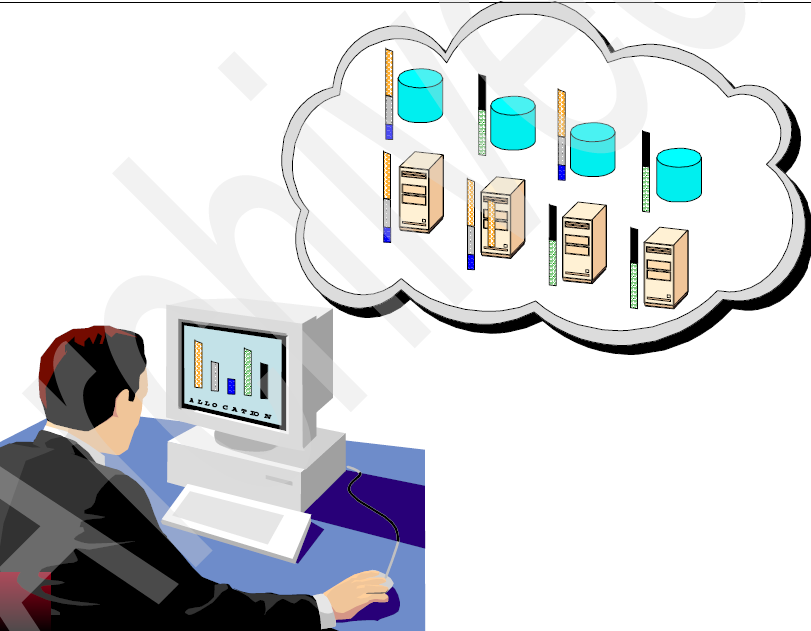
Administrators can adjust policies to better allocate resources
8. Summary
Grid computing enables organizations (real and virtual) to take advantage of various computing resources in ways not previously possible. They can take advantage of under utilized resources to meet business requirements while minimizing additional costs. The nature of a computing grid allows organizations to take advantage of parallel processing, making many applications financially feasible as well as allowing them to complete sooner.
Grid computing makes more resources available to more people and organizations while allowing those responsible for the IT infrastructure to enhance resource balancing, reliability, and manageability.