
Benefits of grid computing
3. Virtual resources and virtual organizations for collaboration
Another capability enabled by grid computing is to provide an environment for ollaboration mong a wider audience. In the past, distributed computing promised this collaboration and achieved it to some extent. Grid computing can take these capabilities to an even wider udience, while offering important standards that enable very eterogeneous systems to work together to form the image of a large virtual computing system offering a variety of resources, as illustrated in the next figure. The users of the grid can be organized dynamically into a number of virtual organizations, each with different policy requirements. These virtual organizations can share their resources collectively as a larger grid.
Sharing starts with data in the form of files or databases. A data grid can expand data capabilities in several ways. First, files or databases can span many systems and thus have larger capacities than on any single system. Such spanning can improve data transfer rates through the use of striping techniques.
Data can be duplicated throughout the grid to serve as a backup and can be hosted on or near the machines most likely to need the data, in conjunction with advanced scheduling techniques.
Sharing is not limited to files, but also includes other resources, such as specialized devices, software, services, licenses, and so on. These resources are virtualized to give them a more uniform interoperability among heterogeneous grid participants.
The participants and users of the grid can be members of several real and virtual organizations. The grid can help in enforcing security rules among them and implement policies, which can resolve priorities for both resources and users.
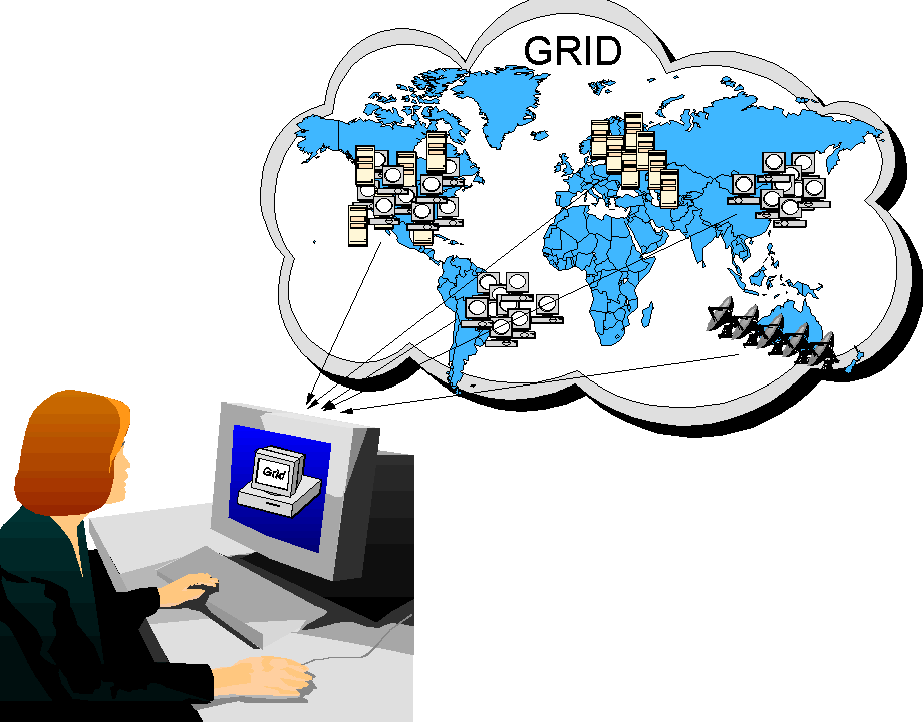
The grid virtualizes heterogeneous, geographically disperse resources