
Although various kinds of resources on the grid may be shared and used, they are usually accessed via an executing application or job. Usually we use the term application as the highest level of a piece of work on the grid. However, sometimes the term job is used equivalently. Applications may be broken down into any number of individual jobs. Those,in turn, can be further broken down into subjobs. The grid industry uses other terms, such as transaction, work unit, or submission, to mean the same thing as a job.
Jobs are programs that are executed at an appropriate point on the grid. They may compute something, execute one or more system commands, move or collect data, or operate machinery. A grid application that is organized as a collection of jobs is usually designed to have these jobs execute in parallel on different machines in the grid.
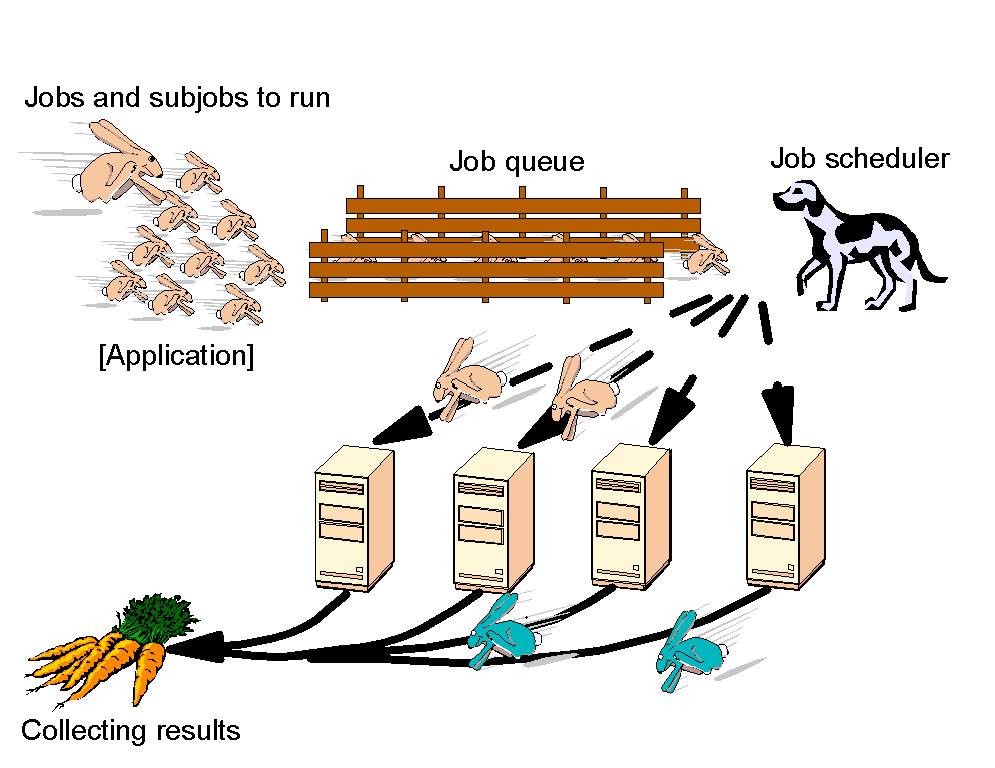
An application is one or more jobs that are scheduled to run on grid.
The jobs may have specific dependencies that may prevent them from executing in parallel in all cases. For example, they may require some specific input data that must be copied to the machine on which the job is to run. Some jobs may require the output produced by certain other jobs and cannot be executed until those prerequisite jobs have completed executing. Jobs may spawn additional subjobs, depending on the data they process. This work flow can create a hierarchy of jobs and subjobs. Finally, the results of all of the jobs must be collected and appropriately assembled to produce the ultimate output/result for
the application.
Last modified: Monday, 16 February 2026, 10:51 AM