
As already mentioned, the definition of a grid is somewhat subjective. Therefore, the following descriptions of various kinds of grids must be taken loosely.
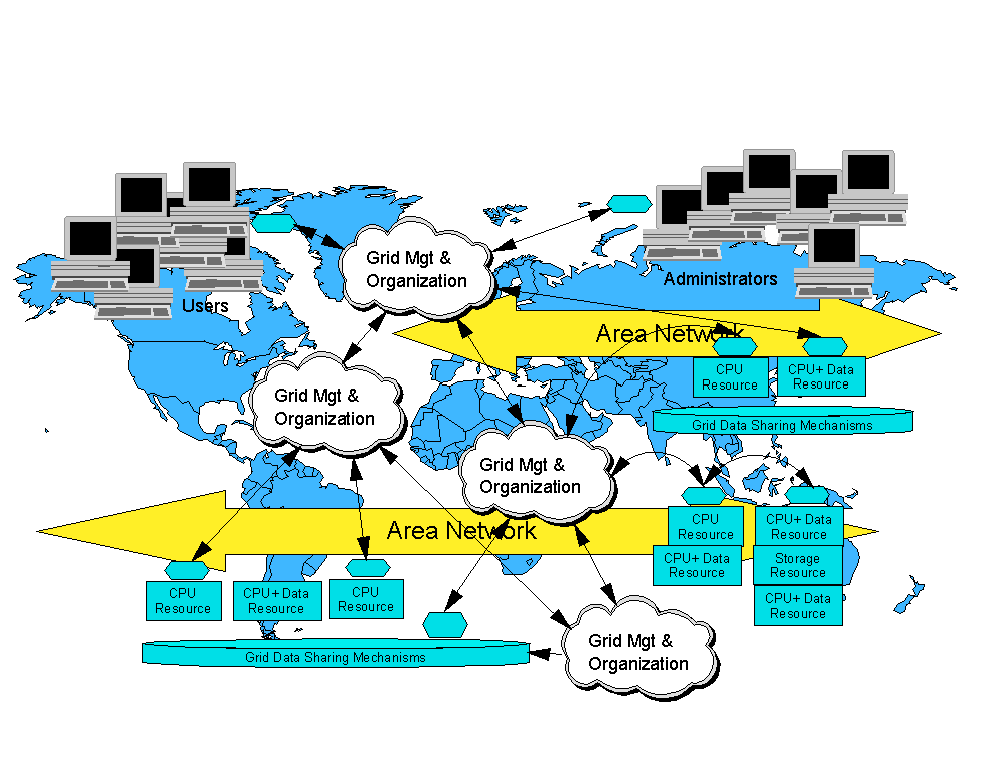
Grids can be built in all sizes, ranging from just a few machines in a department to groups of machines organized as a hierarchy spanning the world. In this section, we describe some examples in this range of grid system topologies.
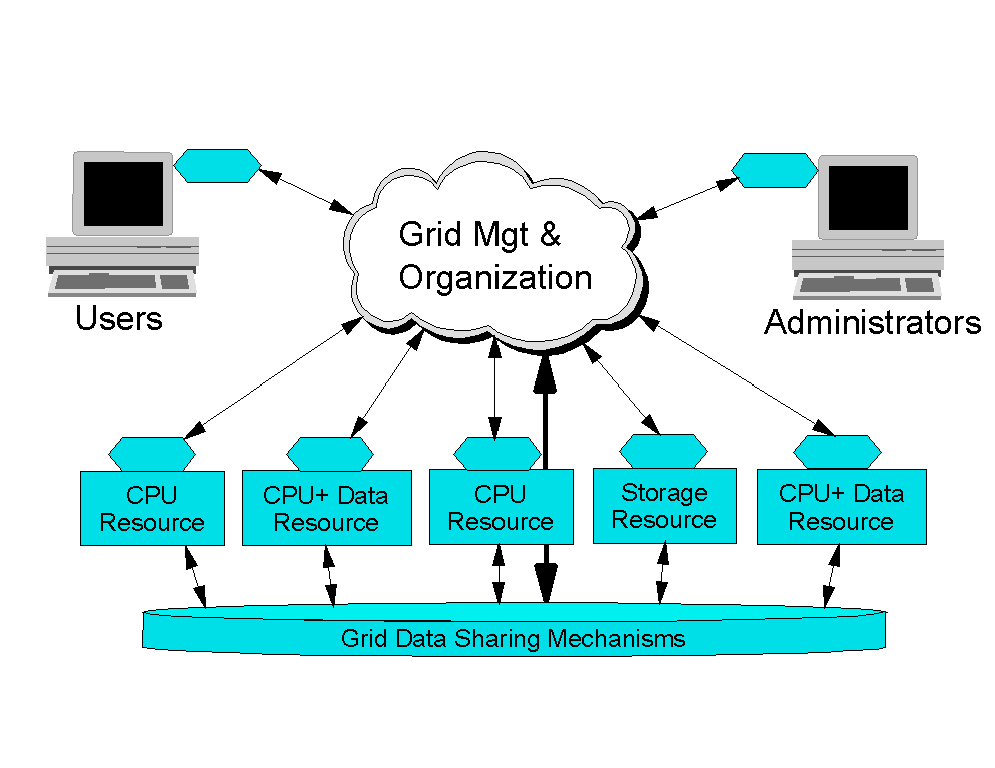
As presented in the above figure, the simplest grid consists of just a few machines, all of the same hardware architecture and same operating system, connected on a local network. This kind of grid uses homogeneous systems so there are fewer considerations and may be used for specialized applications. The machines are usually in one department of an organization, and their use as a grid may not require any special policies or security concerns. Because the machines have the same architecture and operating system, choosing application software for these machines is usually simple. Some people would call this a cluster implementation rather than a grid.
The next progression would be to include heterogeneous machines. In this configuration, more types of resources are available. The grid system is likely to include some scheduling components. File sharing may still be accomplished using networked file systems. Machines participating in the grid may include systems from multiple departments but within the same organization. Such a grid
is also referred to as an intragrid.
As the grid expands to many departments, policies may be required for how the grid should be used. For example, there may be policies for what kinds of work is allowed on the grid and at what times. There may be a prioritization by department or by kinds of applications that should have access to grid resources.
Also, security becomes more important as more organizations are involved. Sensitive data in one department may need to be protected from access by jobs running for other departments. Dedicated grid machines may be added to increase the quality of service for grid computing, rather than depending entirely on scavenged resources.
The grid may grow geographically in an organization that has facilities in different cities. Dedicated communications’ connections may be used among these facilities and the grid. In some cases, VPN tunneling or other technologies may be used over the Internet to connect the different parts of the organization.
Security increases in importance once the bounds of any given facility are traversed. The grid may grow to be hierarchically organized to reduce the contention implied by central control, increasing scalability. Over time, a grid may grow to cross organization boundaries, and may be used to collaborate on projects of common interest. This is known as an intergrid. The highest levels of security are usually required in this configuration. The intragrid offers the prospect for trading or
brokering resources over a much wider audience. Resources may be purchased as a utility from trusted suppliers.
Last modified: Monday, 16 February 2026, 11:13 AM