
The second most common resource used in a grid is data storage. A grid providing an integrated view of data storage is sometimes called a data grid.
Each machine on the grid usually provides some quantity of storage for grid use, even if temporary. Storage can be memory attached to the processor or it can be secondary storage, using hard disk drives or other permanent storage media.
Memory attached to a processor usually has very fast access but is volatile. It would best be used to cache data or to serve as temporary storage for running applications.
Secondary storage in a grid can be used in interesting ways to increase capacity, performance, sharing, and reliability of data. Many grid systems use mountable networked file systems, such as Andrew File System (AFS®), Network File System (NFS), Distributed File System (DFS™), or General Parallel File System (GPFS). These offer varying degrees of performance, security features, and reliability features.
Capacity can be increased by using the storage on multiple machines with a unifying file system. Any individual file or database can span several storage devices and machines, eliminating maximum size restrictions often imposed by file systems shipped with operating systems. A unifying file system can also provide a single uniform name space for grid storage. This makes it easier for users to reference data residing in the grid, without regard for its exact location.
In a similar way, special database software can federate an assortment of individual databases and files to form a larger
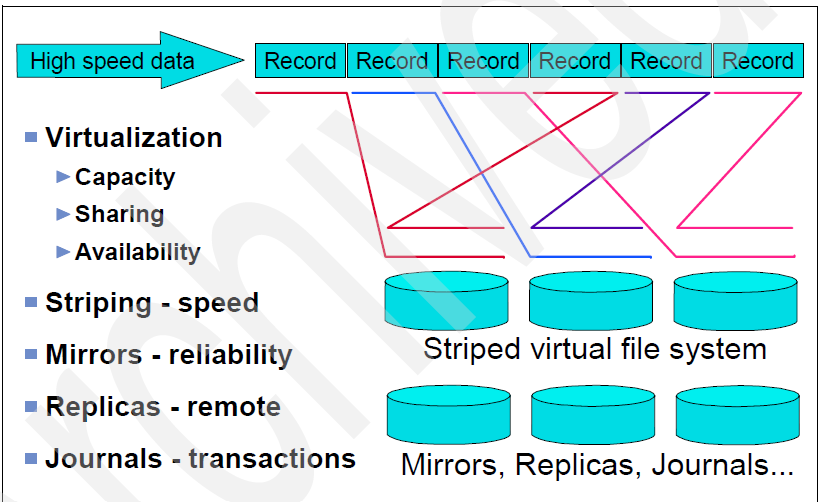
Data striping
Data striping can also be implemented by grid file systems, as illustrated in
The above figure. When there are sequential or predictable access patterns to data, this technique can create the virtual effect of having storage devices that can transfer data at a faster rate than any individual disk drive. This can be important for multimedia data streams or when collecting large quantities of data at extremely high rates from CAT scans or particle physics experiments, for example.
A grid file system can also implement journaling so that data can be recovered more reliably after certain kinds of failures. In addition, some file systems implement advanced synchronization mechanisms to reduce contention when data is shared and updated by many users.
Last modified: Monday, 16 February 2026, 10:37 AM